Troubleshooting Protein Hydrolysis: Yield, Flavor, Filtration, and Spray Drying
Protein hydrolysis problems rarely come from one variable alone. Low yield, bitter flavor, slow filtration, unstable viscosity, or spray dryer fouling usually point to a mismatch between substrate condition, enzyme system, process window, and downstream requirements.
Peptarion is an enzyme supplier for protein hydrolysate production supporting manufacturers that need controlled hydrolysis, consistent batch performance, and practical technical guidance from trial design through production scale-up.
If your plant is seeing inconsistent peptide profiles, yield loss, filtration drag, or powder quality issues, the fastest route is not simply adding more enzyme. The right route is to connect the symptom to the mechanism, then adjust enzyme selection and process control around the finished product target.
Request a quote for enzyme recommendations and production support.
Why hydrolysate production problems show up downstream
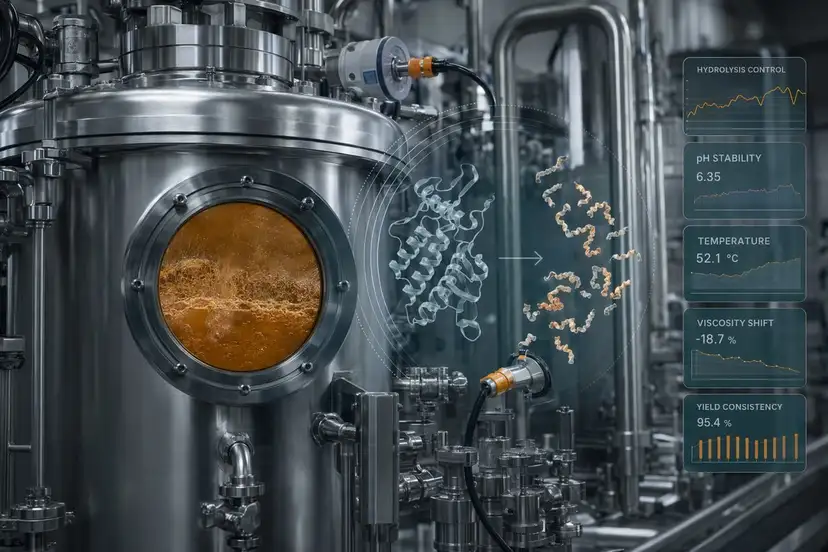
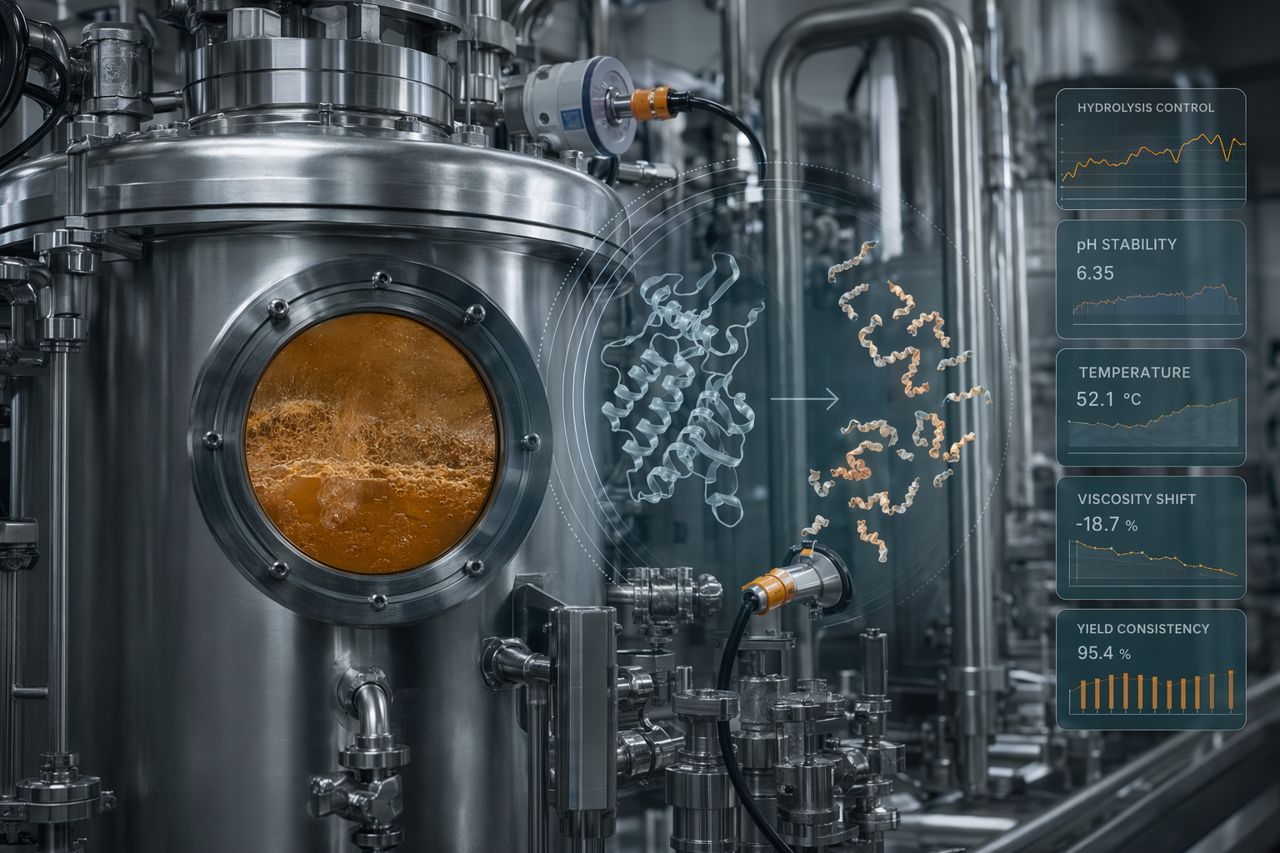
Hydrolysis changes more than protein size. It changes solubility, viscosity, surface activity, bitterness, heat behavior, and the way material moves through separation and drying equipment.
A small change in enzyme specificity or reaction hold can affect:
- Degree of hydrolysis progression
- Peptide size distribution
- Soluble nitrogen recovery
- Emulsion or foam tendency
- Membrane or filter loading
- Evaporator concentration behavior
- Spray dryer wall build-up
- Final flavor and odor profile
- Powder flow, hygroscopicity, and reconstitution
For production managers, the goal is not maximum hydrolysis. The goal is repeatable hydrolysis inside a controllable processing window.
Common problem 1: Yield is lower than expected
Yield loss can appear as incomplete protein conversion, excess insoluble sediment, loss into filter cake, or poor recovery after concentration and drying.
Likely causes
- Protein substrate is poorly preconditioned before enzyme addition
- Enzyme specificity does not match the source protein
- Hydrolysis stops before the required soluble fraction is reached
- Heat history has made the protein less accessible
- pH or temperature drift reduces effective enzyme performance
- Inactivation timing causes continued breakdown or incomplete conversion
- Centrifugation or filtration removes valuable soluble peptides with solids
What to check first
Review the process as a sequence, not as a single reaction step:
- Raw material variability and pre-treatment consistency
- Slurry solids level and mixing quality
- Enzyme addition order and dispersion
- pH and temperature stability during the hold
- Hydrolysis end point definition
- Inactivation method and timing
- Solids separation loss
- Concentration and drying recovery
How Peptarion helps
Peptarion can help identify whether the issue is enzyme fit, substrate accessibility, or process control. We support structured trial plans that compare enzyme systems against your real production targets: yield stability, viscosity, filtration behavior, flavor, and powder quality.
Common problem 2: Flavor is too bitter or harsh
Bitterness is one of the most common commercial barriers in protein hydrolysates, especially for nutrition, functional food, pet nutrition, and fermentation nutrient applications.
Why bitterness develops
Certain proteases release hydrophobic peptide fragments that are highly noticeable in finished products. A process can hit its yield target and still fail sensory requirements if peptide distribution is not controlled.
Practical correction routes
- Shift from aggressive broad cleavage to a more controlled enzyme system
- Combine endoprotease and exoprotease activity to reduce bitter peptide persistence
- Shorten or stage the hydrolysis profile instead of pushing one long reaction
- Adjust inactivation timing to prevent over-hydrolysis
- Improve upstream temperature and pH control to reduce batch-to-batch flavor drift
- Align enzyme choice with final product use, not only conversion speed
The purchasing implication
The lowest enzyme cost per batch is not always the lowest cost product route. If bitterness forces masking, blending, rework, or rejected batches, the enzyme system is creating hidden cost downstream.
Peptarion helps manufacturers select enzyme solutions that support both conversion and flavor control.
Common problem 3: Filtration is slow or unstable
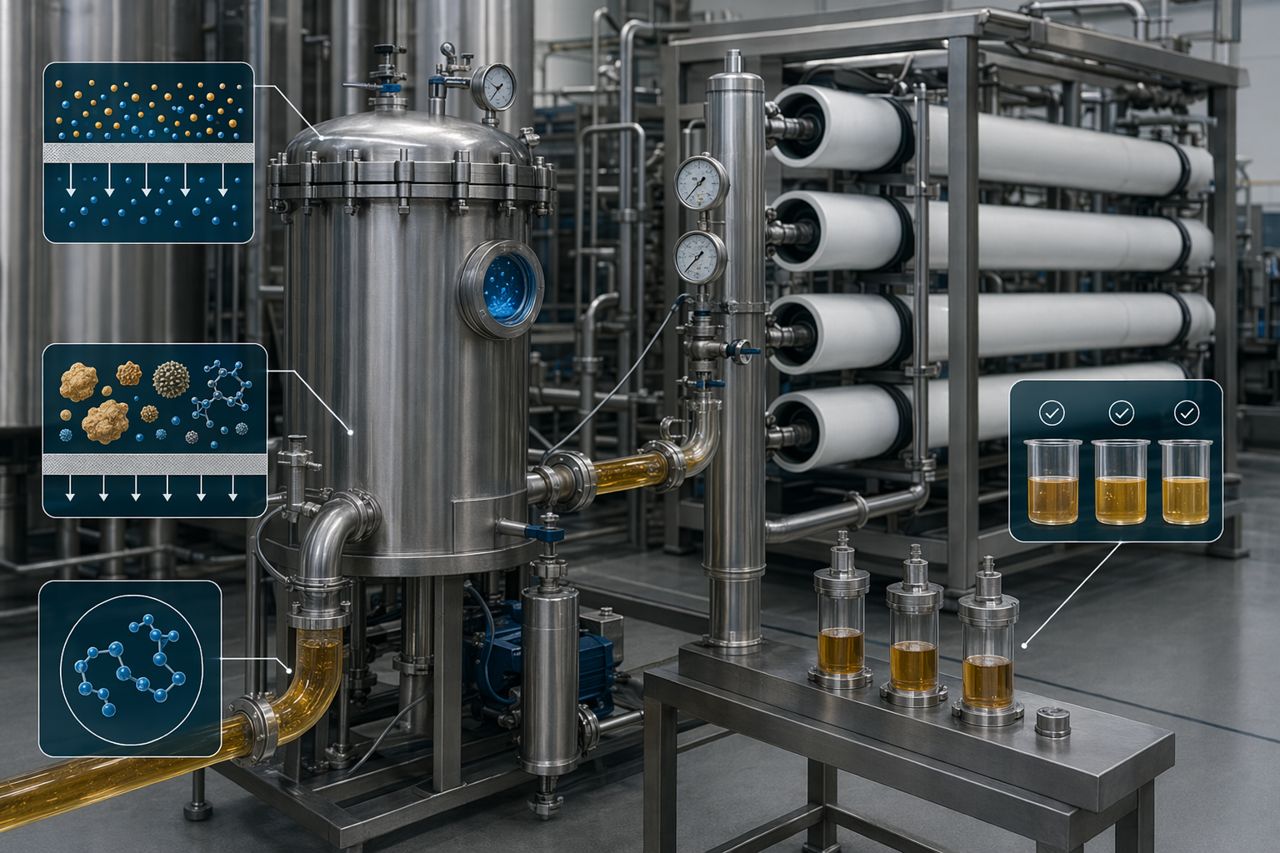
Filtration behavior is one of the clearest signs that hydrolysis is not aligned with downstream processing. A batch may look acceptable in the reactor but overload filters, membranes, or centrifuges.
Signs of poor filtration behavior
- Rapid pressure rise across filters
- High retained solids with soluble peptide loss
- Unstable flux during membrane concentration
- Excess fine particulates
- Sticky or gelatinous filter cake
- Long clarification cycles
- Inconsistent turbidity after separation
Enzyme-related causes
Hydrolysis can create soluble peptides, but it can also expose lipids, carbohydrates, minerals, or denatured protein fractions that interfere with separation. In some substrates, incomplete hydrolysis creates swollen protein fragments that behave poorly in filtration.
Control points that matter
- Substrate particle size and hydration
- Heat pre-treatment severity
- Reaction viscosity change over time
- Hydrolysis end point
- Enzyme specificity
- Inactivation approach
- Holding time before separation
Peptarion support focus
Peptarion evaluates enzyme performance against filtration outcomes, not just reaction progress. For production buyers, that means enzyme recommendations are tied to practical plant behavior: shorter filtration cycles, more predictable separation, and reduced downstream bottlenecks.
Common problem 4: Viscosity does not fall as expected
A controlled viscosity drop is often required for pumping, heat transfer, separation, concentration, and spray drying. If viscosity remains high, the process window narrows and batch timing becomes harder to control.
Typical causes
- Enzyme system is not effective on the target protein structure
- Protein has been denatured or cross-linked before hydrolysis
- Solids are too high for uniform enzyme contact
- Mixing dead zones create uneven hydrolysis
- Reaction conditions drift outside the effective range
- Non-protein components are contributing to viscosity
What to do
Before increasing enzyme addition, verify whether the enzyme is reaching the substrate evenly. In many plants, viscosity problems are tied to hydration, mixing, temperature distribution, and enzyme dispersion rather than enzyme quantity alone.
Peptarion can help design a comparison plan that tracks viscosity shift alongside yield, filtration, and flavor, giving your team a clearer basis for selecting the enzyme system.
Common problem 5: Spray drying creates fouling, low recovery, or poor powder flow
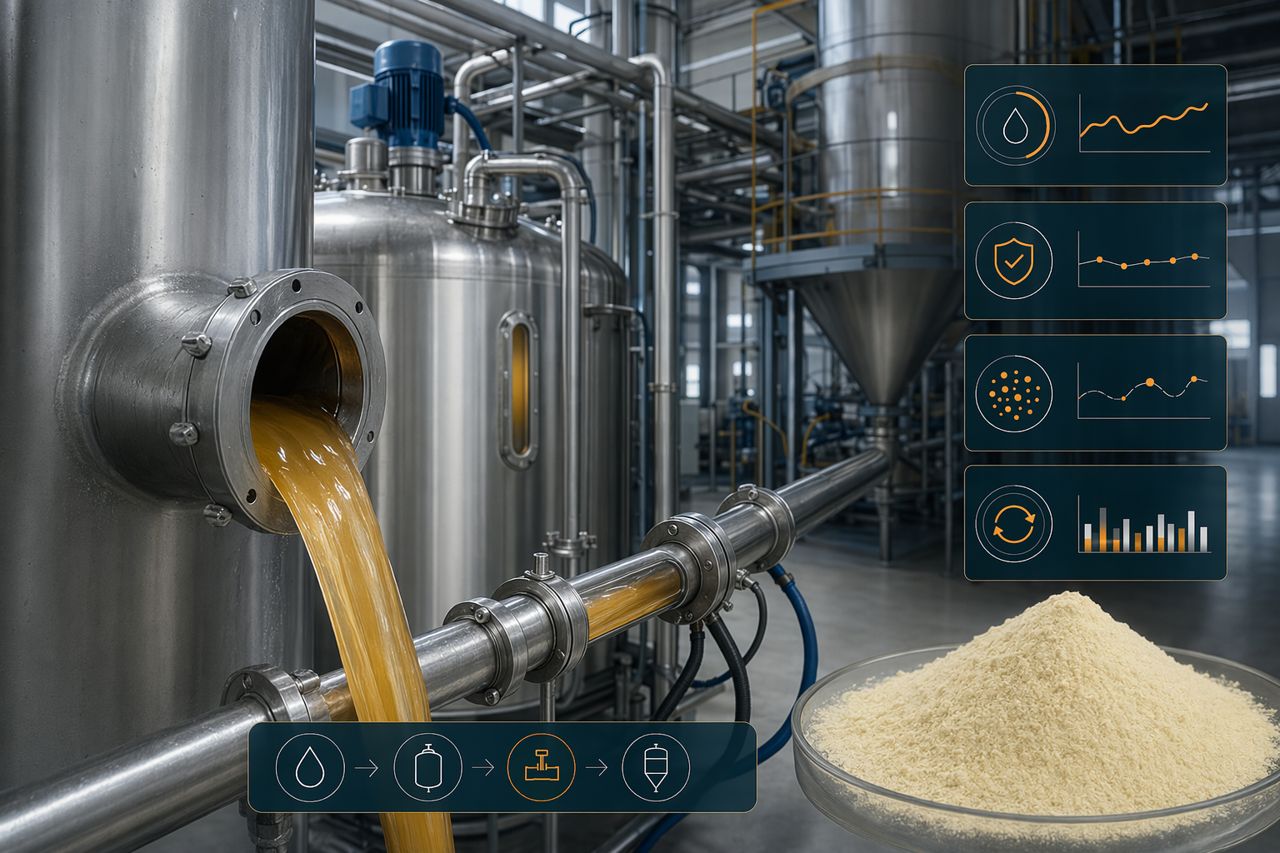
Spray drying problems can begin much earlier in the process. Hydrolysis changes surface activity, stickiness, moisture behavior, and solids composition. If the hydrolysate is not controlled before drying, the dryer becomes the place where the problem becomes visible.
Symptoms in production
- Wall build-up
- Low powder recovery
- Sticky powder
- Poor flow from collection systems
- Variable bulk density
- Reconstitution issues
- Darkening or flavor deterioration
- Higher cleaning frequency
Hydrolysis factors to review
- Peptide profile and soluble solids balance
- Residual insoluble material after clarification
- Viscosity before concentration
- Heat load before drying
- Mineral and sugar contribution
- Final concentration behavior
- Enzyme inactivation reliability
Enzyme selection impact
The enzyme system should be selected with the drying endpoint in mind. A hydrolysate designed only for fast conversion may create a peptide profile that is harder to dry cleanly. Peptarion supports enzyme selection based on the full manufacturing path from slurry to finished powder.
Troubleshooting matrix for production teams
| Production symptom |
Likely process connection |
Enzyme decision to review |
| Low soluble recovery |
Poor substrate accessibility or incomplete hydrolysis |
Match protease specificity to substrate and pre-treatment |
| Bitter flavor |
Hydrophobic peptide accumulation |
Consider enzyme blend strategy and hydrolysis endpoint |
| Slow filtration |
Uncontrolled peptide and particulate profile |
Evaluate hydrolysis stage, inactivation, and separation timing |
| High viscosity |
Incomplete structural breakdown or poor dispersion |
Review enzyme contact, mixing, and process window |
| Spray dryer fouling |
Sticky peptide-solids balance or residual fines |
Select enzyme system with drying behavior in view |
| Batch variation |
Raw material and control drift |
Build a defined process window with technical support |
How to choose an enzyme supplier for protein hydrolysate production
A supplier should do more than ship a protease. For industrial hydrolysate production, the supplier needs to understand the connection between enzyme action and plant performance.
What to look for
- Experience with protein substrates relevant to your process
- Ability to recommend enzyme systems for controlled hydrolysis, not only fast breakdown
- Support for yield, flavor, filtration, and drying objectives
- Practical trial design for scale-up decisions
- Clear documentation and consistent supply
- Technical communication that fits production realities
- Willingness to troubleshoot around your actual equipment constraints
Peptarion works with manufacturers that need reliable enzyme supply and application guidance for protein hydrolysate production. Our focus is controlled conversion, batch repeatability, and downstream process behavior.
Practical route to improvement
A productive troubleshooting program usually follows four steps:
1. Define the failure mode
Do not group all problems under “poor hydrolysis.” Separate yield, bitterness, filtration, viscosity, drying, and batch variability. Each points to different correction routes.
2. Confirm the process window
Map where pH, temperature, mixing, hold time, solids level, and inactivation vary. Small changes can shift peptide profile and downstream behavior.
3. Compare enzyme options against real outputs
Run structured comparisons using your substrate and your product targets. Evaluate more than conversion. Include flavor direction, filtration behavior, viscosity shift, and drying suitability.
4. Move to purchasing with production evidence
Select the enzyme system that delivers consistent performance, not only the lowest input cost. A stable process can reduce rework, shorten bottlenecks, and improve finished product reliability.
Work with Peptarion
If your hydrolysate line is dealing with yield loss, bitterness, filtration drag, viscosity instability, or spray drying issues, Peptarion can help connect the production symptom to the enzyme and process variables behind it.
Use the on-site form to share your substrate, current process outline, target product, and main production challenge. We will respond with a practical enzyme recommendation and quotation path.
Request a quote
Tell us what you manufacture, what protein source you use, and what problem you need to solve. Peptarion will review your requirements and recommend an enzyme supply route for controlled protein hydrolysate production.
Request a quote through the on-site contact form.