Savory Peptide Powder Enzyme Selection | Peptarion
Select protease systems for savory peptide powder manufacturing with controlled hydrolysis, bitterness management, filtration behavior, yield stability, and powder consistency.
Request pricing Select protease systems for savory peptide powder manufacturing with controlled hydrolysis, bitterness management, filtration behavior, yield stability, and powder consistency.
Request pricingSavory peptide powder production depends on controlled hydrolysis, not simply faster protein breakdown. The right protease system should help your plant hold a repeatable processing window, build clean savory depth, manage bitterness, support downstream separation, and deliver powder that behaves consistently from batch to batch.
Peptarion is an enzyme supplier for protein hydrolysate production focused on practical plant outcomes: stable hydrolysis profiles, manageable viscosity, reliable filtration behavior, and technical support that connects enzyme selection to your actual process conditions.
Savory peptide powder manufacturers are usually balancing five production targets at once:
A protease that performs well in a lab screen is not always the best fit for an industrial hydrolysate line. Selection should be based on substrate, target flavor profile, process window, thermal steps, residence time, and the separation method used after hydrolysis.
Savory peptide powders can be produced from many protein sources, including animal, marine, dairy, yeast, soy, pea, wheat, and mixed protein streams. Each substrate responds differently to endoproteases, exoproteases, and blended protease systems.
Peptarion uses these inputs to narrow enzyme options before trial work begins, reducing unnecessary screening and helping your team focus on the protease systems most likely to perform in production.
Savory peptide development is strongly influenced by peptide size distribution and amino acid release. Overly aggressive hydrolysis can generate bitter fractions, while insufficient hydrolysis may leave weak flavor impact, poor solubility, or heavy mouthfeel.
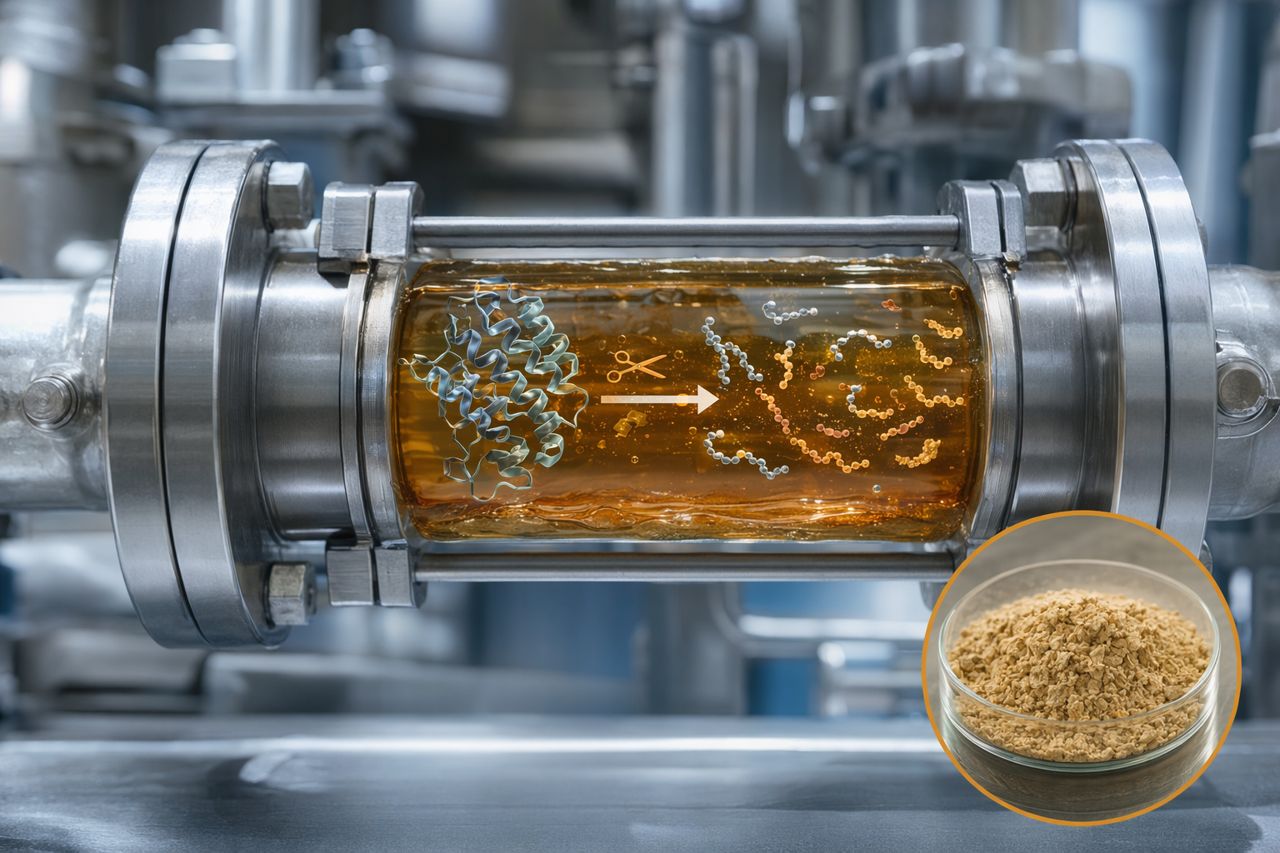
Endoproteases cut internal peptide bonds and are often used to open up the protein structure, reduce viscosity, and create a broad peptide profile. They can support strong hydrolysis progress, but may require careful control to avoid excessive bitterness.
Exoproteases can help modify terminal amino acid release and refine taste balance. They are often used when the process needs more savory roundness, reduced harshness, or a cleaner finish.
Many savory peptide powder processes benefit from a staged or blended enzyme strategy. One enzyme may drive primary breakdown, while another adjusts taste, solubility, or filtration behavior. Peptarion helps evaluate whether a single protease, sequential addition, or custom blend is the better operating choice.
A useful enzyme system should fit the plant you already run. Selection must account for your slurry concentration, pH range, temperature profile, residence time, agitation, heat inactivation step, and downstream equipment.
Peptarion supports selection with application guidance designed for plant implementation, not just bench screening.
For savory peptide powder manufacturers, hydrolysis does not end in the reactor. A protease system that creates good flavor but slows filtration can increase cycle time, labor demand, and rework risk.
Enzyme selection should consider:
Peptarion helps assess enzyme systems against both hydrolysis targets and downstream handling requirements, so the selected solution supports the whole manufacturing route.
Spray drying and final blending are easier to control when the incoming hydrolysate has stable solids behavior, viscosity, and peptide profile. Variation in hydrolysis can show up later as inconsistent powder color, hygroscopicity, solubility, flowability, taste strength, or batch-to-batch seasoning performance.
A well-selected protease system can help improve:
Peptarion works with protein hydrolysate manufacturers to connect enzyme choice with production realities. We help define the operating target, recommend protease options, support comparative trials, and refine the selection based on hydrolysis control, taste direction, separation behavior, and powder requirements.
If you are selecting or replacing enzymes for savory peptide powder manufacturing, Peptarion can help you compare suitable protease systems against your production goals.
Use the on-site form to request a quote. Share your protein source, process temperature and pH range, target flavor profile, downstream separation method, and current production challenge. Peptarion will respond with recommended enzyme options and next-step technical guidance.
Tell us your application and volume — we reply with pricing and lead time.